
-
- Bloomberg
AI Bubble Debate Gets Real as Chip Stocks Rally Turns Historic
This is where the debate comes in. Bulls see a boom driven by structural changes that are transforming the notoriously cyclical semiconductor industry. Bears see an overheated market fascinated by the latest shiny object. And investors are caught in the middle, transfixed by the momentum, but wary of what could come next. “You could see another leg up if you’re looking to buy here, but I keep going back to how volatile chips can be, and how everything can be great until it’s not,” said Ed O’Gorman, chief executive and managing partner at River Wealth Advisors, which holds positions in semiconductor giants Nvidia Corp. and Broadcom Inc. The stakes are high because the stock market has become so reliant on chipmakers for growth. Almost 80% of the S&P 500’s 11% gain this year is coming from just 10 companies — all are in technology, and seven are semiconductor stocks. The two biggest contributors are Micron and Nvidia.
- Bloomberg
AI in the S&P 500
On Friday, AI-related stocks hit a new high as a percentage of the S&P 500.
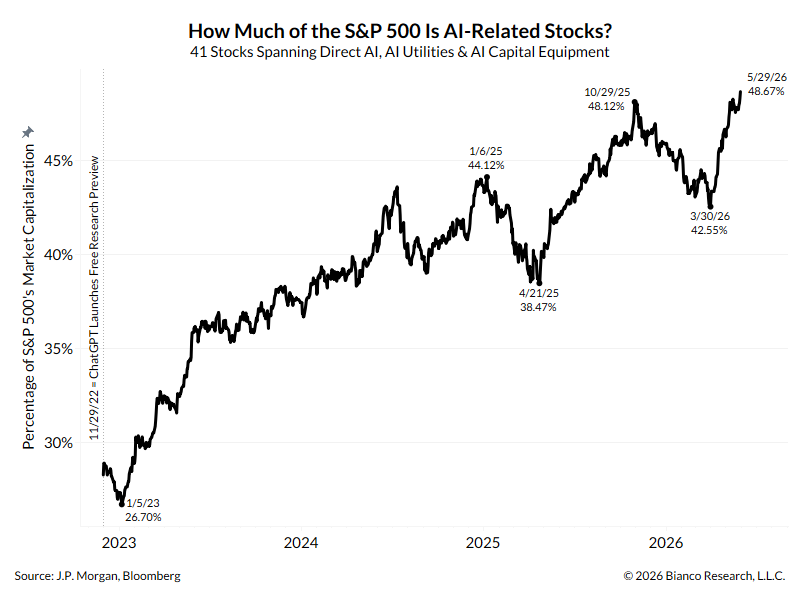
What are the AI-Stocks? We use the list that J.P. Morgan’s Michael Cemblast made last fall.
Here is a table with its details.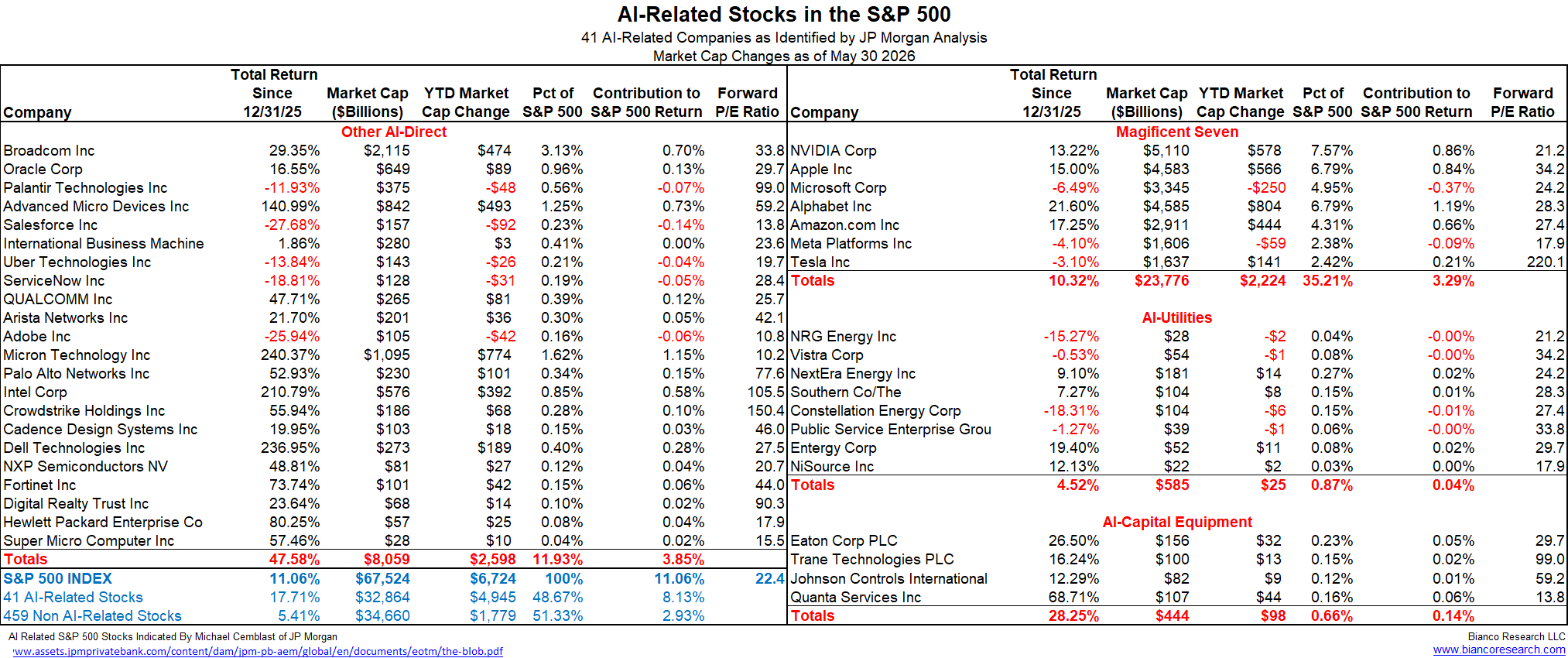
Note that the list above does not include SpaceX (which has Xai, or Grok), Anthropic, and OpenAI. SpaceX’s IPO is expected to take place around June 12.
So, when will they be included in the S&P 500, allowing AI to account for over 50% of the S&P 500?
Last week, S&P proposed changing its rules so that mega-cap IPOs could become eligible for S&P 500 inclusion after six months, rather than the usual one-year seasoning period.
The proposal would also relax some standard hurdles for these companies, including minimum public float and profitability requirements.
But S&P emphasized that eligibility does not mean automatic inclusion; the Index Committee would still make the final decision.
Dissecting the AI Hype Cycle Stage
ChatGPT
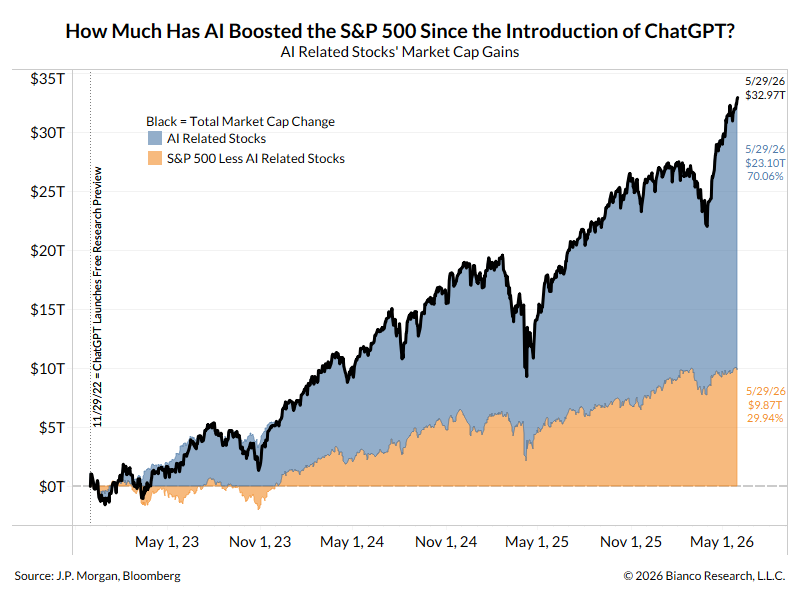
On November 22, 2022, ChatGPT released a free research preview. This is widely acknowledged as the launch of the “Generative AI era.” That is, ask a question, get an answer.
Since this release:
-
-
- The 41 AI-related stocks from the table above (blue) have accounted for 70% of the gains in the S&P 500’s market capitalization.
- The “other 459” accounted for 30% of its gain.
-
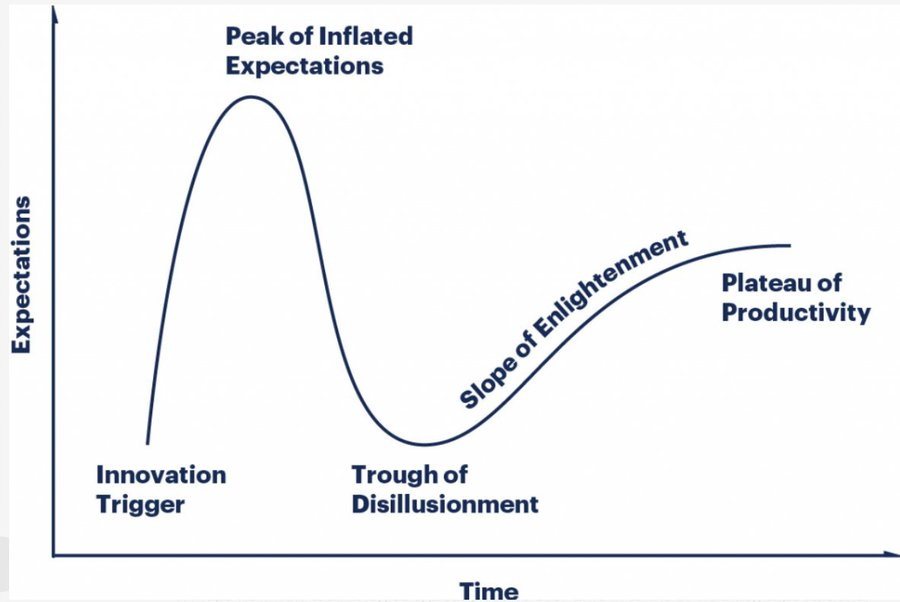
Hype Cycle
This chart shows the generic Gartner Hype Cycle. Yes, the “Peak of Inflated Expectations” is in the future. But we would argue we have a lot of the expectation curve to rise before we get there.
Railroads
In his May 22 “Flow Show,” Michael Hartnett of BofA included this chart.
This chart shows that the stock market is the most concentrated in a single theme in 150 years. The last time we saw anything resembling this level of concentration was the railroads in the late 19th century.
(Note, we are using the table above showing 47%, not the “AI Big 10” showing 40% that Hartnett uses below.)
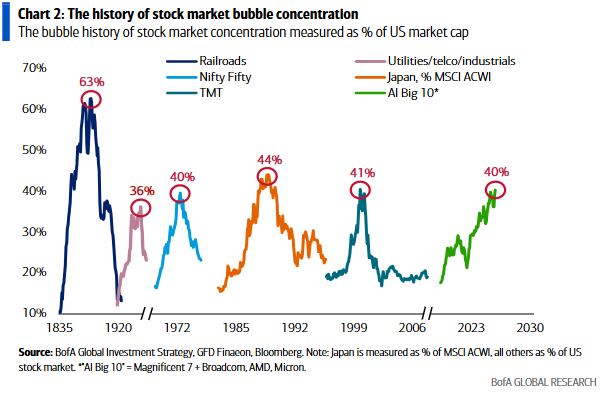
It should be that way!
The railroads literally transformed this country, and no other technology has had this potential until AI.
What Makes AI Spending Work?
Last week, we detailed our case for why AI spending and the CapEx buildout might not be overdone.
Highlights:
Every corporate computer on the planet is loaded with SaaS (Software as a Service) subscriptions costing several hundred to thousands of dollars a month. Examples include Windows, Office, Zoom, Teams, Slack, Salesforce, planning software, Bloomberg, FactSet, Tableau, web browsers, accounting or compliance software, and specialty software applications for your specific job, among others.
The problem is that these SaaS programs don’t talk to each other. So the employee’s job is to spend a significant part of their day juggling data, outputs, formats, and files between these applications. And that employee has invested hundreds, if not thousands, of hours learning to use all this SaaS efficiently.
The problem is that juggling all the SaaS on their computer is the necessary drudgery of their job. Employees’ real value lies in collaborating with co-workers, being creative, and interacting with customers, not in making SaaS programs talk to each other.
If all this SaaS and the time and effort that goes into it can be replaced by one AI prompt window, where you tell your computer what you want, and then most companies will happily pay $1,000/month for AI and pay for it by getting rid of all (or most) of their SaaS. If this happens, the trillions invested in AI will not have been overdone.
If not, and most or all the SaaS stays, and AI is another expense item, then the capital expenditures are overdone.
The iPhone Analogy
Why do you pay $1,100 for a phone, and another $50/month to connect to a mobile service? It is not to make a call.
The mobile phone is many devices at once: a phone, a tape recorder, a stereo, a video recorder, a TV, a web browser, a photo album, a camera, etc.
You pay so much for your phone because you do not have to buy all those other products. That subsidizes the cost of the phone.
Where is AI In The “Bubble Cycle”
February 27 is the day before the war began.
-
-
- The black line is the S&P 500; it is up 10+% since February 27.
- The blue line shows the S&P excluding AI stocks (see the description). It is still down 0.66%.
-
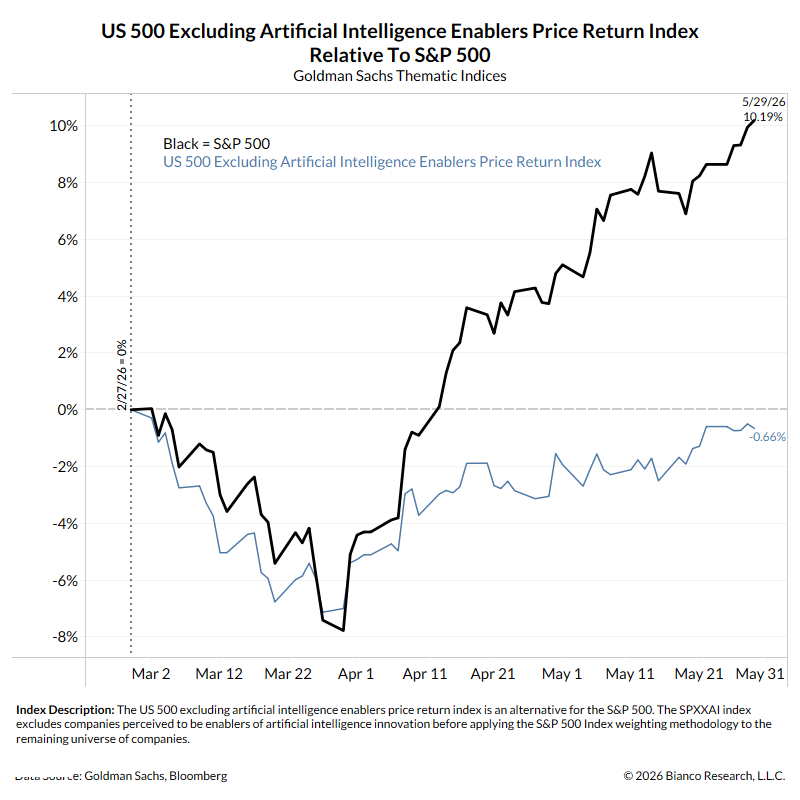
The entire “war rally” in the stock market has been driven by AI. Take out AI, and the rest of the stock market has done little since gasoline started soaring (blue).
Is this a bubble? Probably.
But the more important question, when in the “bubble cycle” are we, rather than just a proclamation that there is one? Remember that bubbles can be both the best time to make a lot of money and the hardest time to hold on to that money (when they pop). Using the internet bubble as a benchmark:
-
-
- Is today more like Dec 5, 1996, when Greenspan warned of “irrational exuberance”? If so, and you were worried about it popping on this date, you missed a nearly 300% rally in the NASDAQ over the next few years.
- Or is it like March 2000, and not worrying about it, exposes you to a NASDAQ correction of almost 80% over the next few years?
-
We believe we are closer to 1997.