
On Federal Reserve Communication
- Financial Times
Kevin Warsh set to revamp Federal Reserve’s signalling to Wall Street
Submitting their dots is an exercise that some on the FOMC have come to despise. Many are also uncomfortable with the excessive focus investors place on the dots as a forecast for interest rates. “The dot-plots were initially viewed as a soft form of guidance, preferable to showing a consensus forecast for the committee,” said Esther George, the former head of the Kansas City Fed. “Though, since then, the interpretation [in markets] has gone well beyond its intended purpose and it’s now seen as guidance on the path of interest rates.” But current and former Fed officials have mixed views over whether or not they can scrap them at a time when the impact of the Iran war on energy prices has already upended markets’ expectations on whether the Fed’s next move will be a cut or rise in rates.
The story above cites what many on Wall Street have quietly acknowledged: The Fed is not a good forecaster, and it shouldn’t pretend to be one.
Warsh, as the newly appointed Fed chairman, has a chance to remake the way the Federal Reserve communicates policy to the world. Warsh is said to believe that forecasts lead FOMC members to stick to their views on the economy long after reality has shifted, driving policy errors, as they avoid being ‘wrong’. We agree!
Since Wall Street scrutinizes Fed statements, dot plots, and speeches to infer hawkishness or dovishness from each, you could see how a member contradicting past views would be put them in an awkward position to answer “why.”
But Warsh is trying to remove that stigma. FOMC members should not be trying to avoid “why were you wrong”; they should embrace that question with one answer: “because the data changed.”
Bill Dudley has his own take.
- Bloomberg
Bill Dudley: The Federal Reserve Requires Better Communication, Not Less
What about the problem of the cacophony of Fed speakers? While I agree that the number and frequency of speeches by FOMC participants about the economic and monetary policy outlook is very high and that it may at times be more confusing than illuminating, I also think there are some good arguments on the other side. First, the wisdom of crowds — the bedrock of prediction markets — suggests that having more perspectives that incorporate a broader set of information leads to better outcomes. Second, when Fed officials publicly disagree, this can be useful in signaling heightened uncertainty about the outlook or in foreshadowing a forthcoming shift in monetary policy. Third, the quality of Fed officials depends, in part, on the attractiveness of the job. If you were, for example, to muzzle the Federal Reserve Bank presidents, I have no doubt that the quality of the candidates would drop. The best way for Fed watchers to deal with the cacophony is to focus on the most important Fed speakers — the Chair, and to a much lesser degree, the two Vice Chairs, who work closely with the Chair (the so-called Troika) and Fed staff in preparing for each FOMC meeting.
SpaceX IPO & The Value of Being a Public Company
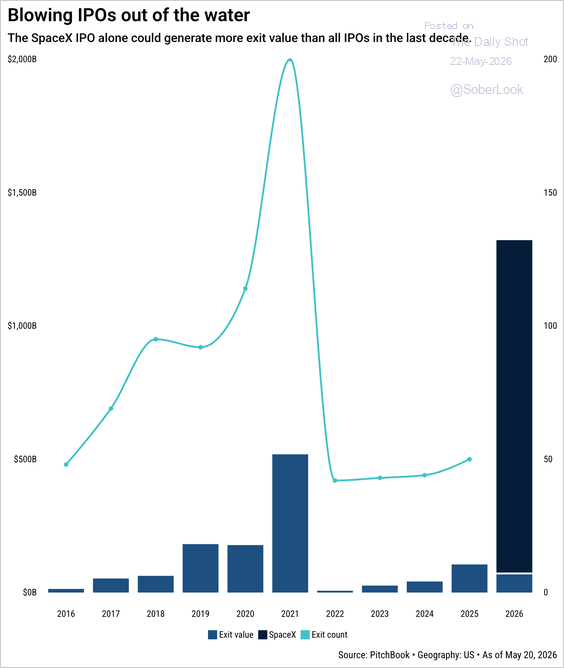
In the last ten years, there have been a total of 750 IPOs. Their total exit value was $1.1 trillion.
SpaceX will exceed all of them combined!
- Reuters
Exclusive: SpaceX plans to set IPO price at $135 per share, targeting record $75 billion raise, source says
Companies planning to go public typically set a price range to frame valuation expectations and allow pricing to be adjusted based on investor demand. Strong demand can push the final price to the top of the range, or above it, ahead of the market debut. SpaceX’s roadshow begins on Thursday. It earlier held some “testing the waters” meetings with investors. The company’s plans, including the size of the raise, are subject to change as investor meetings get underway, the sources cautioned. There is no rule banning SpaceX’s unconventional plan for setting a fixed price for the IPO, said Weiheng Chen, a senior partner in Hong Kong at U.S. law firm Wilson Sonsini Goodrich & Rosati. “Musk is simply taking a ‘take-it-or-leave-it’ approach, which works for his followers and is also sensible given the market conditions and the lack of comparables,” Chen said.
- Wall Street Journal
Alphabet’s Mega Fundraising Shows the Value of Being a Public Company
But the stock market is the obvious place to raise capital to spend on the exciting bits of AI, where returns are unknown, technology is rapidly developing and business models are in flux. Unlike debt, companies don’t have to repay their shareholders, and if it takes longer to make money from AI—or never makes money—the company can simply wait it out if it was financed by stock (though investors would be very unhappy). Alphabet is one of a tiny number of companies capable of raising so much cash without tanking its stock, thanks to its near-monopoly in online search and credibility with Wall Street in new ventures. While $80 billion is huge, it amounts to less than 2% of the market value of the $4.5 trillion company. The stock was down just 2.6% in premarket trading. There seems to be an unlimited supply of willing buyers to fund AI. If it turns out there is a limit, Alphabet can only benefit by going first.
Take the above numbers in. SpaceX is planning a $1.8 trillion IPO and raising approximately $75 billion. Google issued equity to its existing shareholders, raising $80 billion.
The important point here is that everyone in tech, especially in AI, is fighting for one thing: access to capital.
To paint that picture, take this list of AI funding announcements from just in May 2026.
Did You Think Tariffs Were Over?
- CNBC
U.S. proposes fresh tariffs on 60 economies over forced labor trade practices
USTR has proposed a 10% duty rate for economies that have adopted a full or partial prohibition on forced labor trade, and 12.5% for all other economies. The trade authority also proposed a separate textile mechanism that would allow for a certain volume of apparel and textile imports from some economies to enter the U.S. at reduced rates. Written comments for the proposal are due by July 6, with public hearings scheduled on July 7, according to the notice. “The failure of our most important trading partners to address the importation of goods made with forced labor is unacceptable. This creates a dynamic where American workers are forced to compete globally on an unlevel playing field,” said U.S. Trade Representative Jamieson Greer. “We will no longer tolerate this disparity.” The proposal comes after the U.S. Supreme Court struck down most of President Donald Trump’s “Liberation Day” tariffs earlier this year, prompting him to to impose 10% global baseline duties under Section 122 — which are also set to expire in July.
Japanese Inflation & the Yen
- Bloomberg
Yen Holds Near 160 Against Dollar After BOJ’s Ueda Hints at Hike
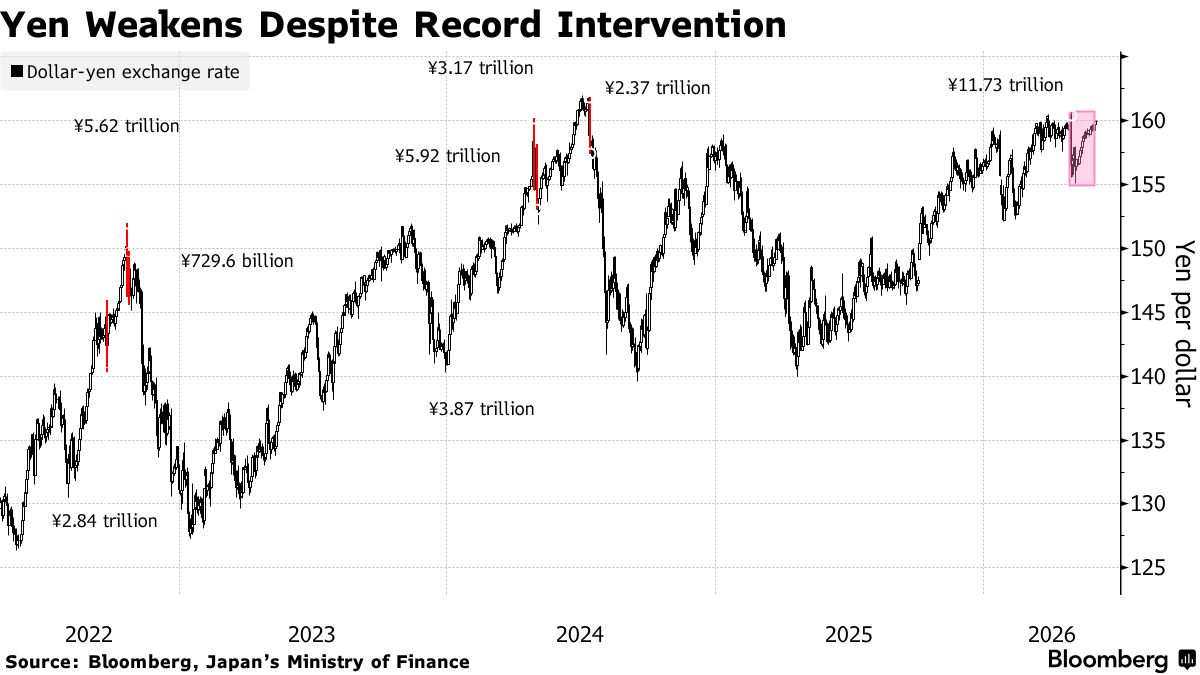
“The BOJ appears to be on track for a June hike,” said Yusuke Miyairi, a currency strategist at Nomura International Plc. “Since the BOJ’s June hike is much priced in, Ueda’s speech won’t change the trend of the dollar-yen pair.” Overnight index swaps show about an 86% chance of a rate hike this month. Pressure on the yen has mounted as negotiations over a permanent US-Iran ceasefire show little sign of a breakthrough. The wide interest rate gap between the US and Japan is also weighing on the currency after the BOJ held rates steady in April. The weakening to the psychological milestone of 160 on Wednesday comes despite Japan spending a record ¥11.73 trillion ($73.35 billion) from April 28 to May 27 to support the currency. The level has also become significant for a large cluster of options contracts to buy or sell the yen. - Bloomberg
Ueda Says BOJ Needs to Keep Raising Rates to Contain Inflation
“Based on the data and anecdotal information available thus far, the upside risks to prices appear to be greater overall and are likely to emerge sooner,” he said. Ueda’s remarks indicate there’s a good chance of a rate hike this month, though they weren’t as explicit as comments he made telegraphing the previous two increases. That suggests the governor wants to preserve some flexibility amid heightened uncertainty over the Middle East situation as well as Prime Minister Sanae Takaichi’s stance on monetary policy. “While not making a policy decision today, he makes clear that a rate hike this month is firmly up for discussion and signs off by expressing confidence that Japan’s economy will be able withstand the current shock,” said Jane Foley, senior FX strategist at Rabobank. “This suggest to me that there is a strong chance that he will be endorsing a rate hike this month.”
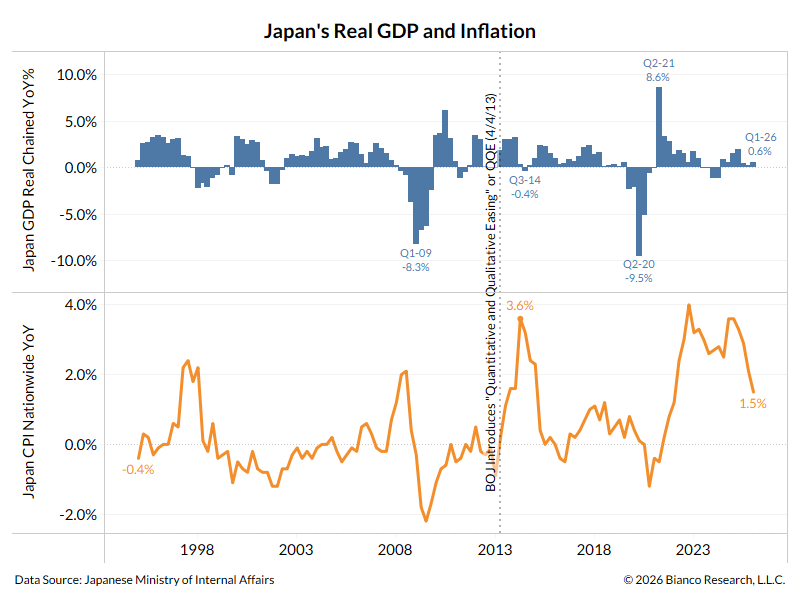
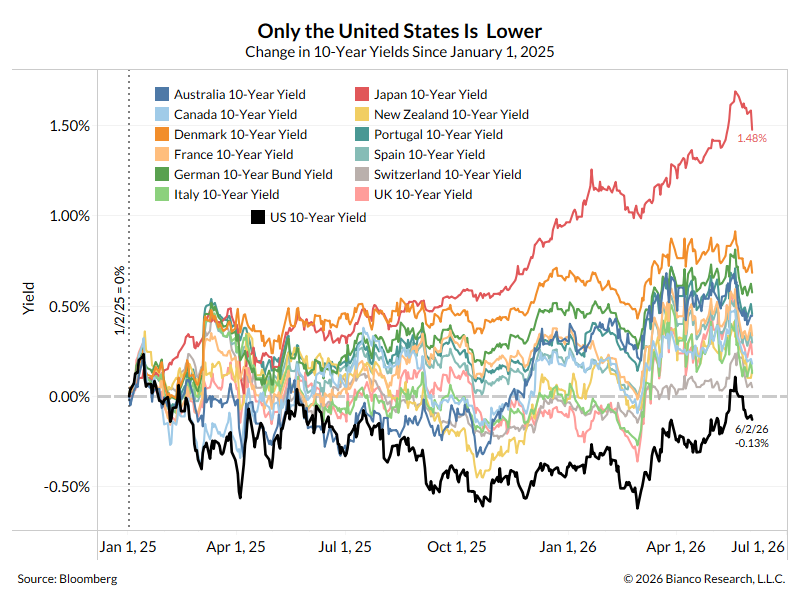
For the three decades before 2022, Japanese inflation averaged around 0.0%.
As the BoJ tries to combat the longest rout of persistent inflation in decades, 10-year JGB yields have been relentlessly rising since 2021.
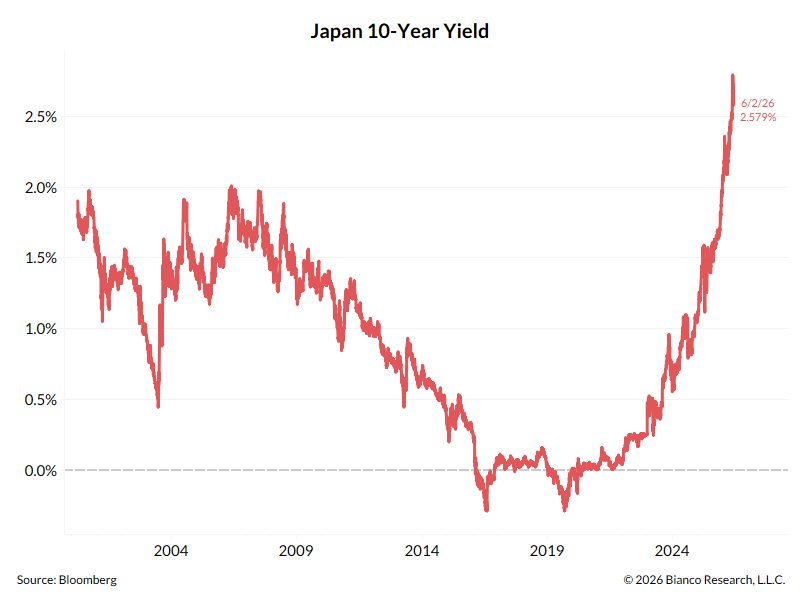
It would be one thing if Japanese yields were rising in line with those of other major economies, but the Japanese 10-year yield has risen much more. For contrast, the Japanese 10-year yield is up 148 basis points since January 1, 2025. The largest move of any major economy. Note that the U.S. 10-year yield is actually the only one lower over that same time period.
Convertible Bond Boom

- Financial Times
US convertible bonds set for record year as issuers harness AI boom
Strong investor demand for exposure to the AI sector, and hundreds of billions of dollars of capital expenditure by the hyperscalers, is helping companies benefiting from the boom but with little in the way of cash flow to issue converts at low cost. “The convert market has historically been a provider of capital for growth companies . . . which are a little desperate,” said Barclays’ Krishna. “If you look at the traditional hyperscalers, they are not the ones who are issuing the convertible bonds because they have a significant amount of their own cash flow,” he added. “The issuers are all either the direct sort of core infrastructure or the secondary, tertiary beneficiaries of AI.”
IPO’s, Indexes, and Price Discovery
- Financial Times
Index investing will evolve with mega IPOs
Float-adjusted indices are not allocating capital based on hype, they are allocating based on investable reality. Even with a relatively small float, SpaceX will probably be the largest IPO to date, so the dollar value available to trade will still be substantial, supporting deep liquidity and efficient price discovery. For most portfolios, the impact may be modest, but in the market, these mega IPOs will probably trade easily from day one. This high liquidity explains why large IPOs are sometimes included in indices sooner than smaller ones. This is often described as a rush, but in practice, it’s the opposite. Large companies that meet size and liquidity thresholds simply satisfy inclusion rules faster than others. What indexing resists, by design, is the temptation to embed narratives into long-term portfolios. Indices don’t predict which IPOs will succeed or stumble. They don’t pass judgment on business models. They take the market as it is. They promise exposure to the investable market over time with clear rules. Sometimes, that means adding companies that later disappoint but it also means owning companies early that go on to reshape industries.